
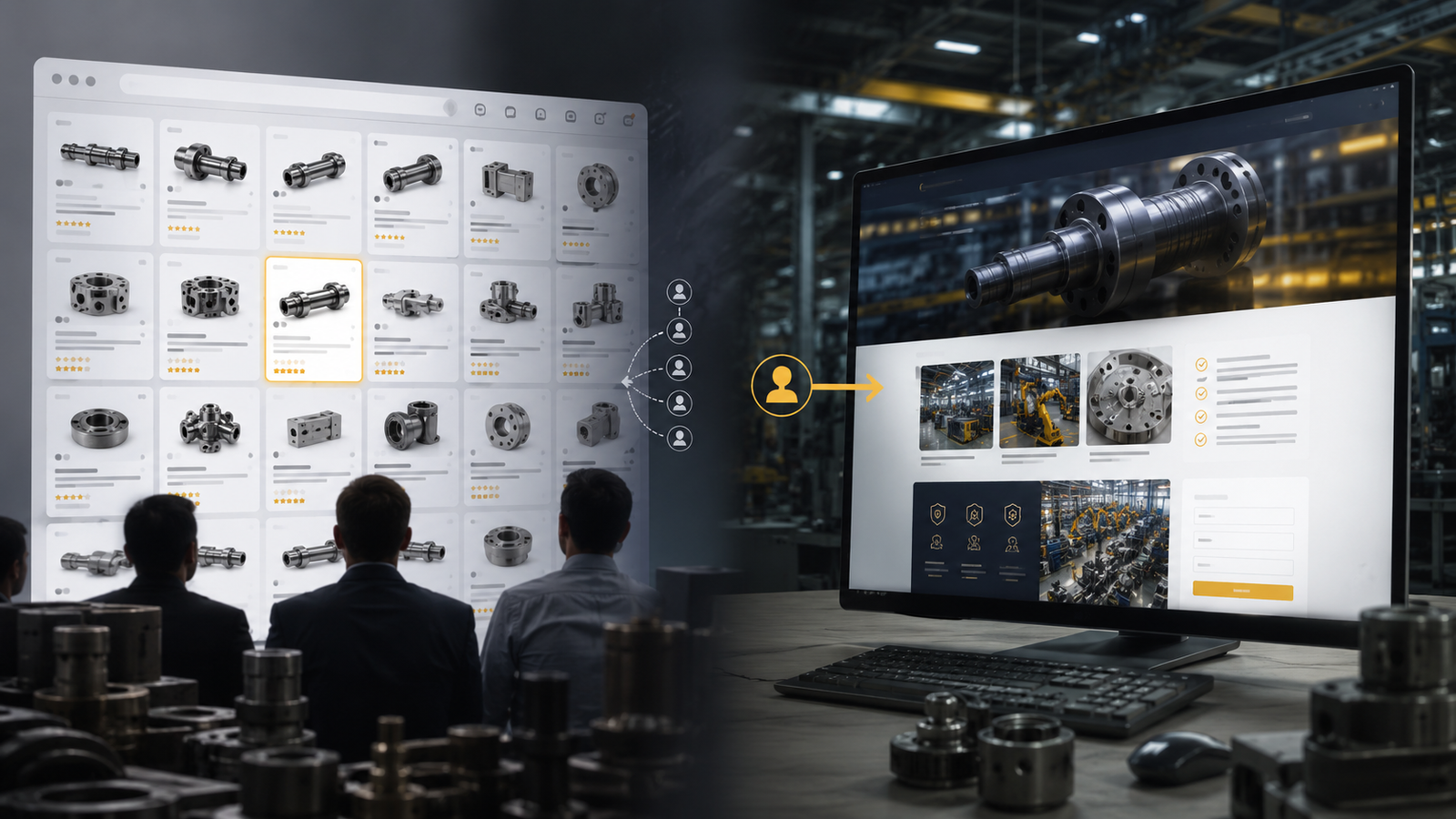
Most manufacturers in Gujarat have a lead generation setup that looks something like this: a listing subscription that gets renewed every year, a website built once and never touched since, and a sales team that chases whatever enquiries come in.
It works, in the sense that enquiries arrive. But it leaves a manufacturer entirely dependent on a channel they don’t control, competing on price in almost every conversation, and owning nothing at the end of five years of spending.
The real question isn’t listing platforms versus your website. It’s whether you’re renting your lead generation or building it. This article covers what digital marketing actually does for a manufacturing business, channel by channel, and how to move budget in that direction without cutting off the enquiries you already get.
A Fair Word on Listing Platforms First
Listing subscriptions do a few things genuinely well, and it’s worth saying so before making the case for anything else.
They produce enquiries fast — days, not months. They need no technical setup, no content, no agency. Procurement teams do browse them, particularly for standard components where the specification is fixed and any qualified supplier will do. And they’re a cheap way to test demand for a new product line before committing real budget.
If you’re getting orders from a listing platform, keep it. Nothing below argues for cancelling your subscription. The argument is that it should be a floor under your pipeline, not the whole of it.
The One Structural Problem You Can’t Fix With More Spend
When a buyer submits an enquiry through a listing platform, that enquiry typically reaches several suppliers at once. Your sales team is calling a buyer who is, at that moment, taking calls from six or seven of your competitors.
The buyer knows nothing about your plant, your quality systems, your delivery record, or your engineering capability. They have your name, your product, and six alternatives in the same inbox. The only variable they can compare across all seven is the rate. So the first question is “what’s your best price,” and everything after that is a negotiation you began from a weak position.
Now consider the same buyer arriving through a Google search. They typed a specification, landed on your product page, read your capacity, saw your certifications, looked at your client list, downloaded your catalogue — then picked up the phone. No competitor was visible on that screen. By the time they contact you, they’ve partly convinced themselves.
Same buyer, same requirement, completely different negotiating position — decided entirely by how they found you. This is why enquiry count is a poor measure of lead generation. An enquiry that starts on price and one that starts on capability are not the same unit.
What Digital Marketing Actually Does for a Manufacturer
There’s a common misunderstanding worth clearing up. “Build your own digital presence” does not mean “build a website and wait.” A website nobody finds generates nothing. The website is the destination. Digital marketing is what brings qualified buyers to it — and for a manufacturing business, that breaks into six specific channels, each doing a distinct job.
1. A website built to survive a procurement review
Before anything else works, the destination has to hold up. Industrial buyers use your website as a filter — they’re deciding whether you’re worth a conversation before they ever call.
That means individual pages for each product or capability rather than one combined “Products” page, real technical specifications rather than marketing copy, visible certifications (ISO, CE, BIS, whatever applies to your category), photographs of your actual plant and processes, a downloadable catalogue, and a client list. Add capacity figures, lead times and export experience if you have them.
Most manufacturer websites fail on all of this. They were built years ago as a brochure, they load slowly, they don’t work properly on a phone, and they answer none of the questions a purchase manager actually has. Fixing the website is the least glamorous part of this work and the one that determines whether every other channel converts.
2. Search visibility on product and specification terms
This is the channel that changes a manufacturer’s economics, and it’s the one almost nobody in Indian manufacturing does properly.
B2B buyers don’t search in slogans. They search in specifications — material grades, standards, part descriptions, application terms, often with a city or state attached. These queries have low monthly volume and, in most industrial categories, almost no serious competition, because so few manufacturer websites have product pages worth ranking at all.
Low volume is not a weakness here. A term searched forty times a month by procurement engineers who need exactly what you make is worth far more than a general term searched four thousand times by students and job seekers. Forty highly qualified searches a month, across thirty such terms, is a pipeline.
The work involves identifying the terms your buyers actually use, building a page for each product or application, writing genuine technical depth into those pages, and structuring the site so search engines can understand your full range. It takes three to six months to show results and it compounds from there — rankings earned this year keep producing next year at no additional cost per enquiry.
3. Google Ads on high-intent search
Where SEO is slow, paid search is immediate, and unlike a platform enquiry the lead is exclusively yours.
The discipline is bidding only on buying-intent terms. Search campaigns only. Tight keyword lists built around specifications and supplier queries. Negative keyword lists doing real work to filter out students, job seekers and researchers. Landing pages that match the exact product searched for, not the homepage. Call tracking so you know which term produced which enquiry.
What you don’t do is display advertising, awareness campaigns, or broad match left to run unsupervised — that’s where most manufacturer ad budgets get wasted.
Cost per enquiry on industrial search terms often looks expensive next to a listing subscription, until you set it against deal size and conversion rate. A costlier enquiry that closes at a workable margin beats a cheap one that never gets past the rate discussion. And running ads while SEO builds means you’re not waiting six months for the first result.
4. LinkedIn for reaching the buying committee
Listing platforms make you wait for a buyer to come looking. LinkedIn lets you reach purchase managers, procurement heads, plant heads and technical directors directly — before a requirement is even floated.
This matters because B2B purchases are almost never decided by one person. There’s a committee: someone technical who evaluates capability, someone commercial who evaluates price, someone senior who signs. A listing enquiry reaches one of them. LinkedIn lets you be visible to all three.
The work has three parts. A company page that’s actually maintained, with plant updates, capability additions, certifications and completed projects. Personal posting from the founder or MD — in industrial sectors, a credible individual voice consistently outperforms a corporate page. And targeted outreach or sponsored content aimed at specific job titles within specific industries and locations, which LinkedIn does better than any other platform.
The result is recognition. When the requirement lands, you’re already a known name rather than one of seven quotes.
5. Google Business Profile and local search
Regional buyers search by city and by proximity constantly — “manufacturer near me,” “supplier in Vadodara,” and similar. A claimed, complete, actively maintained Google Business Profile puts you in those results at no cost.
It needs the right primary category, every service listed with a proper description, weekly photos, regular posts, and reviews from customers. Most manufacturers have either no profile at all or one auto-created years ago and never touched. It’s the cheapest visibility available and the most commonly ignored.
6. Email and catalogue nurture for long cycles
Industrial buying cycles run six to eighteen months. Someone who enquires in March may not have budget approval until the following January.
Without a nurture system, that enquiry is lost. The sales team follows up twice, gets nothing, moves on, and a live prospect quietly goes cold. With one, you stay present through product updates, new certifications, capacity additions and case studies — so when the requirement finally becomes real, you’re already in the consideration set.
Every enquiry you have ever received is an asset here, including the ones that didn’t convert. Most manufacturers are sitting on a list of several hundred qualified contacts and doing nothing with it.
Tying it together
These six channels aren’t alternatives to each other. Search and ads bring buyers to the website. The website convinces them. LinkedIn builds recognition before they search. The Business Profile catches regional demand. Email holds the ones who aren’t ready yet.
Run together, they produce enquiries where the buyer already knows who you are and what you can do — which is a fundamentally different sales conversation from a shared platform lead. This is what a digital marketing company in Vadodara should be building for a manufacturing client: not activity, but a pipeline you own.
What This Looks Like in Practice
A manufacturing client came to us with the familiar setup — a listing subscription, an outdated website, and a sales team working entirely on shared enquiries.
We rebuilt the product pages, set up tracking, and launched a tightly targeted search campaign alongside it. The first qualified enquiries came through within seven days of launch — exclusive ones, from buyers who had read the capability pages before making contact.
Four months in, the client told us they had closed their first order from the channel at ₹28 lakh. Not a trial order or a sample enquiry — a full order from a buyer who found them through their own digital presence rather than a shared listing.
Two things are worth drawing out of that. The first enquiries arrived in a week, because paid search doesn’t wait for rankings. And the deal took four months to close, because that’s simply how long industrial buying cycles run — which is exactly why the nurture and follow-up systems matter as much as the lead generation itself.
What This Actually Requires
An article that made this sound effortless wouldn’t be worth reading.
It’s slower to start. Search visibility takes three to six months. Paid search fills that gap, but the compounding channels need patience.
It needs technical input from inside your company. Product pages with real specifications cannot be written by an agency alone. Someone in your engineering or sales team has to give substance. This is the single most common reason manufacturer content projects stall.
It requires consistency. Rankings that are built then neglected decay. A LinkedIn presence that goes quiet stops working. This is ongoing, not a project with a completion date.
Year one costs more than a subscription and returns less. The returns show up in years two and three, when the assets are working and cost per enquiry starts falling.
Side by Side
| Listing platforms | Your own digital marketing | |
|---|---|---|
| Time to first enquiry | Days | Immediate with paid search, 3–6 months organic |
| Enquiry exclusivity | Shared with competitors | Exclusive to you |
| Typical first conversation | Price negotiation | Capability discussion |
| Reaches the buying committee | One contact only | Technical, commercial and decision-making roles |
| Who owns the relationship | The platform | You |
| If you stop paying | Visibility ends immediately | Rankings, content and list keep working |
| Cost over 5 years | Rises annually, resets to zero | Falls per enquiry as assets compound |
| What you own at the end | Nothing | Website, rankings, content, contact list, audience |
How to Split the Budget
The answer isn’t one or the other. It’s what proportion, and which direction you’re moving.
Year one. Keep the listing subscription for enquiry flow while everything else is being built — but cap it at its current level instead of upgrading. Put the incremental budget into the website, product pages built to rank, and a focused paid search campaign that starts producing exclusive leads in week one.
Year two. Organic search should be delivering. Hold the subscription flat again. Increase content and SEO investment, add LinkedIn properly, and start email nurture on the enquiry base you’ve now collected.
Year three. Your own channels are the pipeline and the subscription is a supplement. Renewal becomes a choice rather than a dependency.
At a total budget of around ₹50,000 a month in year one, a workable split is roughly half to website and search foundations, a quarter to paid search, and the remainder to LinkedIn and Business Profile management. At ₹1 lakh a month, the same shape holds with more weight on content depth and paid search, plus room for sponsored LinkedIn campaigns rather than organic activity alone.
Exact figures depend on your product, margin and geography. The direction of travel doesn’t.
The First 90 Days
If you’re starting from a standing position, this is a realistic sequence.
Weeks 1–3. Audit the current website against what a procurement team needs. Claim and complete the Google Business Profile. Research the specification and application terms buyers in your category actually search.
Weeks 4–8. Rebuild or restructure product pages, one per product line, with real technical content. Set up analytics, call tracking and enquiry attribution so you can tell which channel produces what. Launch a tightly controlled Google Ads search campaign.
Weeks 9–12. Start publishing supporting content — application guides, technical explainers, case studies. Activate the LinkedIn company page and founder posting. Import every historic enquiry into an email list and send the first nurture communication.
By day 90 the paid channel should be producing exclusive enquiries, and the compounding channels are laid down and beginning to move.
The Question Worth Asking
Not “which channel gives more enquiries this quarter.” Ask instead: if you stopped all marketing spend tomorrow, what would you still have?
If the answer is nothing, you’ve been renting. And the rent goes up every year.
Frequently Asked Questions
How do manufacturers generate B2B leads through digital marketing?
Through six connected channels — a website built for procurement review, search visibility on product and specification terms, high-intent Google Ads, LinkedIn outreach to the buying committee, an optimised Google Business Profile, and email nurture for long buying cycles. Together they produce exclusive enquiries from buyers who already understand your capability.
How long does SEO take for a manufacturing company?
Three to six months for meaningful traffic on product and application terms, longer in categories with established competitors. Paid search fills the gap while organic visibility builds.
How much should a manufacturer spend on digital marketing per month?
Most small and mid-sized manufacturers see workable results starting around ₹50,000 per month across website, search and LinkedIn. The right figure depends on product margin, deal size and category competitiveness.
Is LinkedIn worth it for manufacturing companies?
Yes, because industrial purchases are decided by a committee rather than one person. LinkedIn is the only channel that lets you reach technical, commercial and decision-making roles directly, and build recognition before a requirement is floated.
Are B2B directory subscriptions worth it in 2026?
They work as a baseline for immediate enquiry flow, particularly for standard components. They shouldn’t be your only channel — enquiries are shared with competitors, conversations start on price, and you build no lasting asset.
Tatvamasi Digital works with manufacturers and B2B businesses across Gujarat on search visibility, paid campaigns, and LinkedIn lead generation. If you’d like a straight assessment of where your enquiries are coming from and what they’re actually costing you, schedule a consultation.